What was once known as a medical chair has become one of the most celebrated pieces of modern furniture design. The Paimio Chair was designed in the early 1930s by Finnish architect Alvar Aalto, who created the perfect blend of beauty, function and comfort. The Paimio Chair’s unique design history shows just why it remains an icon of Scandinavian furniture.

The Origins of the Paimio Chair
The Paimio Chair was actually created as part of a much larger project, the Paimio Sanatorium. In 1929, there was an architectural competition held for the construction of this tuberculosis hospital. This is where Alvar Aalto and his wife Aino Aalto won the commission to design the building itself, as well as all of the elements inside. The building was completed just four years later in 1933.
At the time, tuberculosis treatment emphasized fresh air, rest, and comfort. Aalto approached the entire building and its furniture components as a “medical instrument,” carefully designed to promote healing. The Paimio Chair was developed by Aalto around 1931–1932, and was specifically created for the patients’ lounge in the sanatorium. What is seen as an aesthetic piece of furniture today was originally crafted from a holistic vision of health and wellness.
 Paimio chairs in the Paimio Sanitorium | Photo: Gustaf Wellin/Alvar Aalto Foundation
A Chair Designed for Health
The human-centered design is what makes Aalto’s Paimio Chair a revolutionary piece of furniture. Unlike many modern designs of his time period, Aalto fully focused on comfort and the human body instead of industrial logistics.
The backrest of the chair has a gently reclined angle, which was carefully calculated to make breathing easier for tuberculosis patients. It has a flowing and curved form to naturally support the body, which reduces strain and encourages relaxation. This commitment to ergonomics was ahead of its time and reflects Aalto’s mindset that design should always serve people first.
 Alvar's wife, Aino Aalto, sitting in the Paimio Chair | Photo: Alvar Aalto Foundation
Construction and Materials
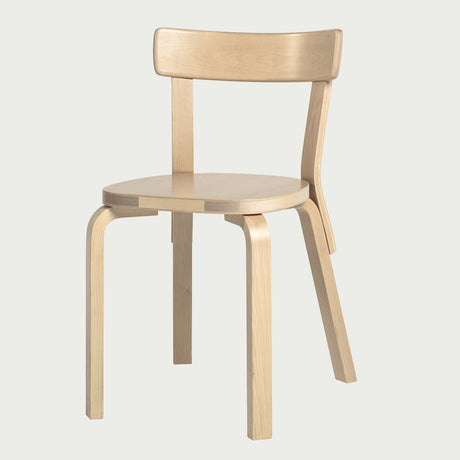
The Paimio Chair is famous for its highly innovative use of wood. Molded from a continuous piece of spring birch plywood on a closed frame, the Paimio Chair was Aalto's brainstorm for making a wooden chair "soft.”
The frame is crafted from laminated birch, which is bent into a closed curve with solid birch cross-rails. The seat is made from a single piece of laminated plywood with a similar closed curve. These curves on each side are why the piece is often referred to as the Paimio “Scroll” Chair. Especially unique is the chair’s cantilevered form, meaning it does not have traditional back legs with vertical support attached to the bottom.
 These design decisions led to a chair that was lightweight yet strong, flexible yet supportive, as well as warm and inviting. By 1934, the chair was made entirely from Finnish birch, allowing it to be marketed as “100% Finnish” in design and materials.
While many designers of his era chose rigid lines and industrial materials, Aalto drew inspiration from nature, human needs, and traditional craftsmanship. The Paimio Chair reflects these pillars through its flowing lines and natural materials. The form of the chair itself feels more like a sculpture than a machine-made object.
From Medical Furniture to Design Icon
Although originally designed for a hospital, the Paimio Chair quickly gained international recognition. It was first introduced to the general public in 1932 in Helsinki, Finland. It then showcased at international exhibitions, including Milan, going on to mass production and global markets. The chair became a defining piece of modern design and is now included in major museum collections, including the Museum of Modern Art (MoMA).
The Paimio Chair was initially produced by Finnish manufacturer Otto Korhonen and then later by the design company Artek, founded in 1935 by Alvar Aalto, his wife Aino Aalto, Maire Gullichsen, and Nils-Gustav Hahl. The chair continues to be manufactured today by Artek, who makes sure to preserve its original design and craftsmanship.
The Paimio Chair reminds us that good design is not just about the look, but about improving the user’s life. It also remains a symbol of Finland’s design philosophy of simplicity, functionality, and connection to nature. From a tuberculosis sanatorium in Finland to modern homes and museums worldwide, the Paimio Chair shows us what timeless design really means.