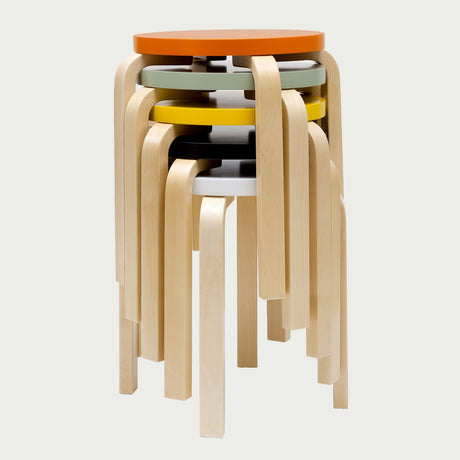
The seemingly simple Stool 60 has become one of the most influential objects in modern furniture design. It was designed by Finnish architect Alvar Aalto in 1933, and has remained in continuous production in its original form ever since. Its timeless appeal has become of symbol of the Finnish philosophy: functional form, innovative thinking, and human-centered design.

Origins and Historical Context
Alvar Aalto’s Stool 60 was created during a period of widespread experimentation in the modern design world. Many designers in the early 20th century, like those associated with the Bauhaus movement, were exploring more industrial materials such as steel. Aalto choose to go a different direction with his designs, welcoming in natural materials like warm wood.
Aalto originally designed Stool 60 for seating in the lecture hall at the Vyborg (Viipuri) Library, which is now in Russia. It then debuted in November 1933 in London at the Wood Only exhibition, resulting in a breakthrough on the international stage for Finnish furniture design. This popularity led to the founding of Artek in 1935, the company Aalto co-founded with his wife Aino Aalto, Maire Gullichsen, and Nils-Gustav Hahl to produce and distribute the stool, along with his other furniture designs.
 Stool 60 at the Viipuri Library in Vyborg, Russia (1933-1934)
Design and Innovation
Stool 60 appears deceptively simple at first glance. In essence, it’s just a round seat supported by three legs. However, its true innovation lies in the construction of those supporting legs. Aalto had developed a patented technique known as the “L-leg,” which allowed solid birch wood to be bent into a right angle without breaking.
This process involved cutting slits into a piece of wood, inserting layers of glued veneer, and then bending the material using heat and steam. The result is a strong, durable leg that could be directly attached to the seat bottom without complex assembly. This innovation was groundbreaking at the time for many reasons. It enabled efficient and sustainable mass production and created a clean, minimalist aesthetic that was able to transcend time and trends.

Materials and Craftsmanship
Stool 60 is made from Finnish birch, an ideal material for both its availability and its qualities. Birch is strong, flexible, and visually appealing. It has an organic warm tone that seamlessly suits any interior. The minimalist stool has three major pieces: solid birch legs (formed using the L-leg technique), a circular seat made from birch veneer, and simple screw connections for assembly.
The stool is still manufactured at Artek’s own factory in Turku, Finland from native birch trees. These trees are grown, felled, and seasoned in central Finland. Each harvested tree ranges from 50-80 years old, and the timber’s 12 month drying process ensures the best quality birch for each and every stool. After 90+ years, the stool keeps a sense of craftsmanship, as each piece of wood has unique grain patterns to give every stool subtle individuality.

Functionality and Versatility
One of Stool 60’s most applauded features is its stackability. Aalto's three-legged design allows multiple stools to be stacked vertically, making them ideal for spaces where flexibility and storage are important. These compact, spiraling towers are both attractive and space-saving.
Beyond seating in public and private spaces, the stool has endless functions. Often regarded as one of the most versatile furniture pieces, it can be used as a side table, a plant stand, a coffee table, a display pedestal and more. This reflects Aalto’s belief that design should serve everyday life in practical and meaningful ways.

Cultural Impact and Legacy
Since its introduction in 1933, Stool 60 has remained in continuous production, which is an extraordinary achievement in the world of design. It has been included in major museum collections, most notably the Museum of Modern Art (MoMA), and has sold in the millions worldwide.
Today, Stool 60 has been expanded with new colorways and wood finishes, along with new collaborations with various brands. Its influence also extends far beyond its original form. The L-leg technique became a significant element in Aalto’s later furniture designs, like Chair 65, Bench 153 and various tables.
Stool 60 has come to be a perfect example of how timeless design does not need to be complicated. Through a combination of innovative construction, thoughtful material choice, and a deep understanding of human needs, Alvar Aalto created an object that remains the most popular stool in the world over 90 years later.